Independent Rankings · 2026 Season

Best Antarctica, Falklands & South Georgia Cruises 2026

The Falklands–South Georgia–Antarctica route is the most complete Antarctic expedition on earth — three distinct ecosystems, the highest wildlife density of any polar itinerary, and 17–25 days of genuine expedition travel. This independent guide ranks the best operators running this route in 2026.

See the Rankings

Why This Is the Ultimate Antarctica Falklands South Georgia Cruise

No other Antarctic itinerary matches the combination of subantarctic wildlife, Southern Ocean history, and polar wilderness packed into a single voyage. The Falkland Islands deliver five penguin species — king, gentoo, Magellanic, rockhopper, and macaroni — alongside albatross colonies and elephant seals. South Georgia adds the “Serengeti of the Southern Ocean”: king penguin colonies numbering in the hundreds of thousands at St. Andrews Bay and Salisbury Plain, southern elephant seal beaches, Antarctic fur seals, and Grytviken — the former whaling station where Ernest Shackleton is buried. The Antarctic Peninsula completes the circuit with Adélie and chinstrap penguin colonies, humpback and minke whales, leopard seals, and ice formations found nowhere else on earth.

This route follows guidelines set by the International Association of Antarctica Tour Operators (IAATO) and operates within the framework of the Antarctic Treaty System, the international agreement governing all activity on the continent.

2026 Operator Comparison

Operator Ship Max Passengers Duration Price From IAATO Best For
Poseidon Expeditions M/V Sea Spirit 114 19–23 days $8,577 ✓ Since 2011 Max time ashore, no rotations
National Geographic / Lindblad NG Endurance / Resolution 148 20–23 days ~$20,000 Premium education & science
Aurora Expeditions Greg Mortimer / Sylvia Earle 130 18–23 days ~$13,995 Active adventure, X-Bow hull
Quark Expeditions Ultramarine 172 19–23 days ~$15,995 High-tech, helicopter landings
Antarctica21 Magellan Explorer 72 12–21 days ~$14,995 Fly+cruise, boutique comfort
Heritage Expeditions Heritage Discoverer 64 ~21 days ~$16,500 Traditional expedition, purist feel

Prices are per person in a twin cabin, based on publicly listed rates as of June 2026. Always verify current pricing with operators directly.

The 6 Best Antarctica Falklands South Georgia Cruise Operators in 2026

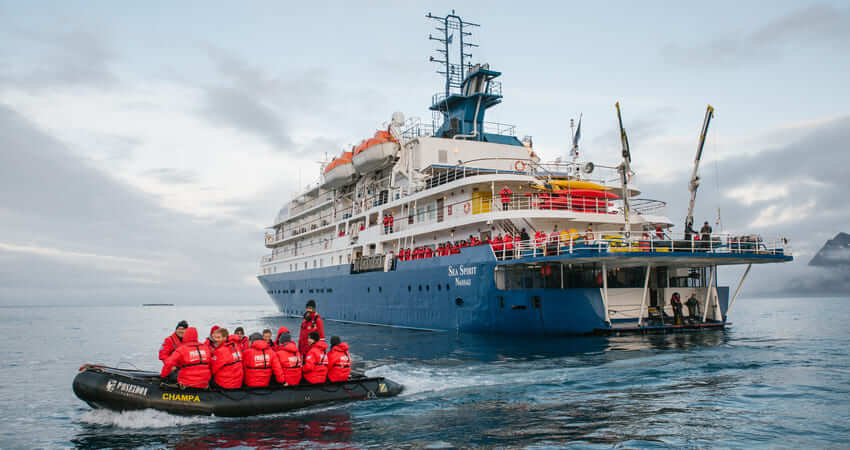
M/V Sea Spirit — Poseidon Expeditions Antarctic cruise ship
1

Best overall for maximum time ashore and genuine expedition access on this route.

Ship: M/V Sea Spirit Passengers: 114 Duration: 19–23 days Price From: $8,577 Embarkation: Ushuaia, Argentina IAATO: Member since 2011

Poseidon Expeditions has operated small-ship polar expeditions since 1999 — 27 years of Arctic and Antarctic experience anchored by one vessel, the 114-passenger M/V Sea Spirit. The ship’s ice-strengthened hull and high maneuverability allow access to narrow fjords and remote bays that larger vessels cannot enter.

All 114 guests go ashore simultaneously — no group rotations. IAATO enforces a limit of 100 passengers ashore at any single site simultaneously; at 114 passengers total, Sea Spirit operates within the optimal size bracket for Antarctic landings.

The expedition program includes up to 3 landings per day, with an average of approximately 2.5 hours of off-ship activity per landing. Optional activities — sea kayaking through iceberg formations and overnight camping under the Antarctic sky — are available at additional cost and fill quickly. The onboard expedition team comprises naturalists, wildlife biologists, geologists, and historians.

Pros

  • Up to 3 landings per day averaging 2.5 hours each — highest shore time of operators reviewed
  • All guests ashore simultaneously; no rotation system means no waiting
  • Optional sea kayaking and overnight camping in Antarctica

Cons

  • One ship limits departure date flexibility vs. multi-vessel operators
  • Optional activities (kayaking, camping) book out months in advance
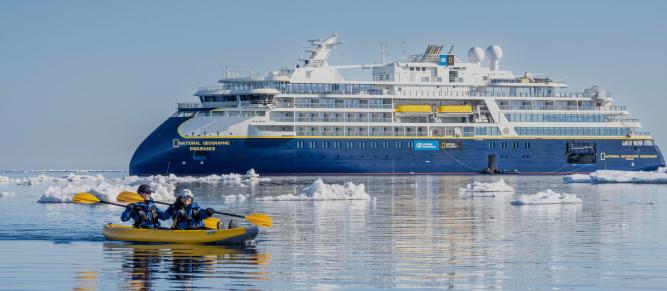
National Geographic Endurance — Lindblad Expeditions ship
2

Best for travelers who want premium onboard education combined with immersive science and photography programming.

Ship: NG Endurance / Resolution Passengers: Up to 148 Duration: 20–23 days Price From: ~$20,000 Embarkation: Ushuaia, Argentina IAATO: Member

Lindblad Expeditions has partnered with National Geographic since 2004, creating a distinctive expedition formula that places scientists, photographers, and naturalists alongside guests throughout the voyage. Both vessels — National Geographic Endurance and National Geographic Resolution — are purpose-built for polar expedition work with PC5 ice class ratings.

Every National Geographic / Lindblad voyage includes a National Geographic certified photo instructor and access to underwater remotely operated vehicles (ROVs) on select departures.

Pros

  • Unmatched onboard education and photography programming
  • Purpose-built polar ships with PC5 ice class
  • National Geographic brand credibility for wildlife interpretation

Cons

  • Price point ($20,000–$50,000+) is significantly higher than comparable operators
  • Larger passenger count means IAATO rotation system applies at some landing sites
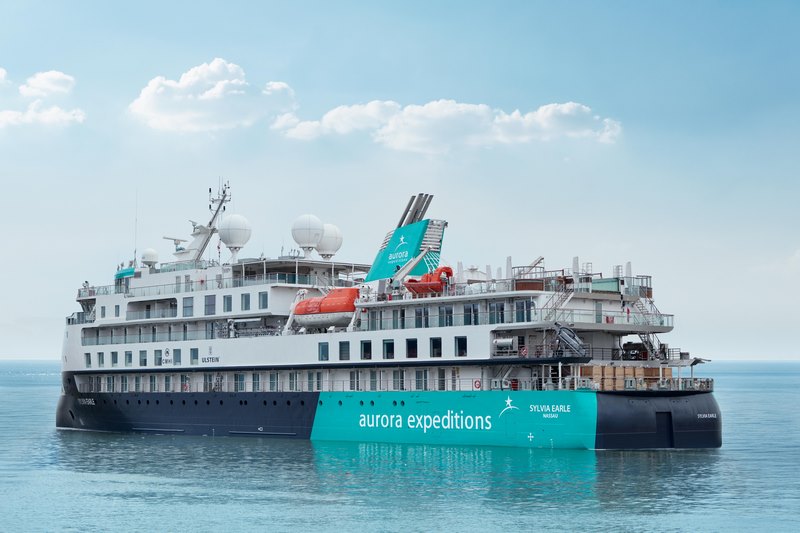
Greg Mortimer — Aurora Expeditions Antarctic ship
3

Best for adventure-focused travelers who want an active expedition with a smoother Drake Passage crossing.

Ship: Greg Mortimer / Sylvia Earle Passengers: Up to 130 Duration: 18–23 days Price From: ~$13,995 Embarkation: Ushuaia, Argentina IAATO: Member

Aurora Expeditions operates two X-Bow hull vessels — Greg Mortimer and Sylvia Earle — designed specifically to reduce pitch and roll in the Southern Ocean. The X-Bow design cuts through swells rather than riding over them, which measurably reduces motion discomfort on the Drake Passage crossing.

X-Bow hull technology: developed by Ulstein Group to reduce wave impact and passenger motion in open ocean conditions. Both Aurora vessels use this design for the Drake Passage and Scotia Sea crossings.

Pros

  • X-Bow hull provides smoother Drake Passage crossing
  • Widest range of optional adventure activities (kayaking, mountaineering, snowshoeing)
  • Competitive pricing relative to comparable small-ship operators

Cons

  • Popular departure dates sell out well in advance; early booking essential
  • Activity-heavy format may not suit travelers seeking a more relaxed expedition pace
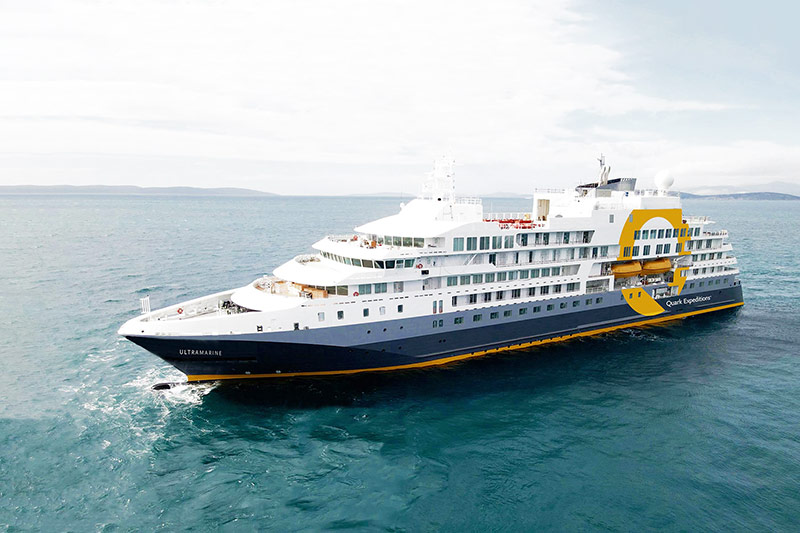
Ultramarine — Quark Expeditions Antarctic ship
4

Best for travelers seeking unique access methods and the most technologically advanced Antarctic expedition ship currently operating.

Ship: Ultramarine Passengers: Up to 172 Duration: 19–23 days Price From: ~$15,995 Embarkation: Ushuaia, Argentina IAATO: Member

Quark Expeditions launched Ultramarine in 2022 as one of the most technically capable expedition vessels in the polar market. The ship carries two helicopters and 20 two-person kayaks, enabling landing access methods unavailable on any other Antarctic operator’s vessel.

Ultramarine operates two onboard helicopters, allowing landings at sites inaccessible by Zodiac — a capability unique among Falklands–South Georgia–Antarctica operators.

Pros

  • Only operator running helicopters on this route
  • Modern vessel (2022) with high comfort standards
  • Strong onboard naturalist and expedition team

Cons

  • Largest vessel in this ranking at 172 passengers — IAATO rotations apply at most sites
  • Higher price relative to equivalent shore-time operators
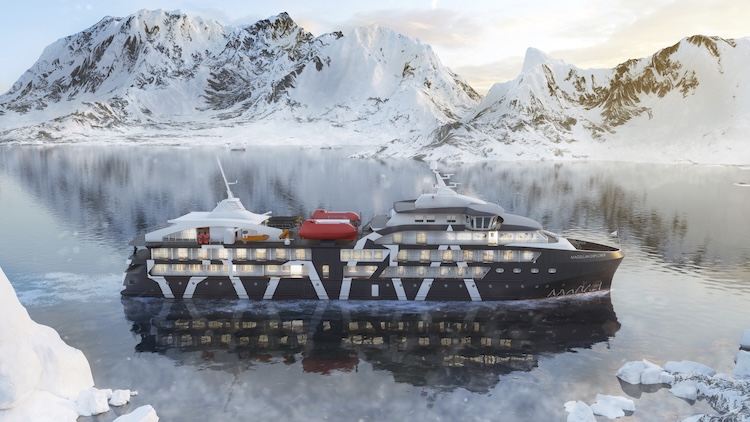
Magellan Explorer — Antarctica21 cruise ship
5

Best for travelers who want to skip the Drake Passage or prefer a smaller, boutique vessel with yacht-like comfort.

Ship: Magellan Explorer / Discoverer Passengers: Up to 72 Duration: 12–21 days Price From: ~$14,995 Embarkation: Punta Arenas, Chile IAATO: Member

Antarctica21 pioneered the fly+cruise format for Antarctic travel: passengers fly from Punta Arenas to King George Island in 2 hours, bypassing the Drake Passage entirely, and board the ship directly in Antarctic waters. The full sea-crossing option is also available.

Fly+cruise: Punta Arenas → King George Island by charter flight (approx. 2 hours), then directly aboard ship in Antarctic waters. Drake Passage crossing: approximately 2 days each way by sea.

Pros

  • Fly+cruise option eliminates Drake Passage entirely
  • 72-passenger maximum: all guests ashore simultaneously at every site
  • Boutique atmosphere with high staff-to-guest ratio

Cons

  • Not all departures include the full three-destination sequence
  • Punta Arenas embarkation requires routing through Chile
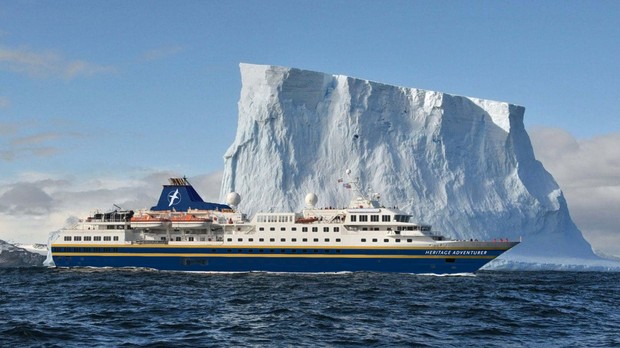
Heritage Discoverer — Heritage Expeditions polar ship
6

Best for purist expedition travelers who want authentic small-ship exploration without commercial polish.

Ship: Heritage Discoverer Passengers: Up to 64 Duration: ~21 days Price From: ~$16,500 Embarkation: Ushuaia, Argentina IAATO: Member

Heritage Expeditions was founded in 1984 and has accumulated over 35 years of polar expedition experience across both hemispheres. The company operates Heritage Discoverer — a 64-passenger vessel that keeps the passenger count well below IAATO landing limits, ensuring all guests go ashore without rotation at every site.

64 passengers: the smallest vessel in this ranking. Every guest lands at every site, simultaneously, with no waiting.

Pros

  • Smallest vessel (64 passengers) — most intimate landing experience reviewed
  • 35+ years of polar expedition experience; deep naturalist expertise
  • Every guest ashore simultaneously at every site

Cons

  • Fewer departure dates than larger operators
  • Onboard amenities are functional rather than premium

How We Rate Operators

Shore Time

We measure average landings per day, average time ashore per landing, and whether all passengers land simultaneously or in rotation groups. Shore time is the single most important variable on this route.

Ship Size & IAATO

Vessels carrying 500+ passengers cannot make Antarctic landings. Vessels with 100+ passengers must use rotation systems. We favour operators whose ship capacity allows maximum simultaneous shore access.

Expedition Team

We assess the qualification mix of each operator’s expedition staff: naturalists, wildlife biologists, geologists, historians. We also weight guest ratings of guide quality across verified review sources.

Value & Activities

We compare price-per-day against included activities, optional add-ons (kayaking, camping, helicopter access), and cabin standard at the base price tier.

See our full methodology →

Wildlife Across Three Destinations

Falkland Islands

Subantarctic Archipelago · South Atlantic

  • King penguin
  • Gentoo penguin
  • Magellanic penguin
  • Rockhopper penguin
  • Macaroni penguin
  • Black-browed albatross
  • Striated caracara
  • Southern elephant seal
  • South American fur seal
  • Falkland steamer duck

South Georgia

“Serengeti of the Southern Ocean”

  • King penguin — colonies of tens of thousands
  • Southern elephant seal
  • Antarctic fur seal
  • Humpback whale
  • Wandering albatross
  • Macaroni penguin
  • Gentoo penguin
  • Grytviken — Shackleton’s grave

Antarctic Peninsula

The White Continent

  • Chinstrap penguin
  • Adélie penguin
  • Gentoo penguin
  • Humpback whale
  • Minke whale
  • Orca (killer whale)
  • Leopard seal
  • Weddell seal
  • Tabular icebergs

Why Ship Size Determines Your Antarctic Experience

Not all expedition vessels can make Antarctic landings. Under IAATO guidelines, two rules define what’s possible on the ice:

100

Rule 1: No more than 100 passengers may land at any single Antarctic site simultaneously.

500+

Rule 2: Vessels carrying more than 500 passengers are prohibited from making any Antarctic landings.

What this means in practice: operators with ships carrying 150–250 passengers must run rotation systems — groups land in shifts while others wait aboard. Operators with ships at or below 114 passengers (like M/V Sea Spirit) can land all guests at once, at every site, with no rotation. The difference is not abstract: on a 19-day voyage, the gap in total shore time between a rotation operator and a no-rotation operator can amount to 8–12 full hours of additional landing time.

Source: IAATO Field Operations Manual

When to Go: Antarctica Falklands South Georgia Cruise Season Guide

October – November

Early Season

Best for Photographers

Active breeding behavior across all three destination zones. Falklands penguin colonies arrive and establish nests. South Georgia elephant seals compete for beach territory. Antarctica landscapes are pristine with undisturbed snow cover.

Consider: Weather is more variable; some wildlife behaviors are pre-peak.

December – January

Mid Season

Peak Season

Peak activity across all three zones. King penguin chicks hatch at St. Andrews Bay. Penguin colonies at full capacity. Maximum daylight (18–22 hours) maximizes landing time and photography windows.

Consider: Most popular window — book 12–18 months in advance for preferred cabins.

February – March

Late Season

Best for Whales

Humpback and minke whale aggregations increase as Antarctic sea ice melts and krill concentrations peak. Penguin chicks begin to fledge. Iceberg formations are more varied as ice breaks up.

Consider: Some penguin colony sites begin to thin as chicks fledge and disperse.

The Three Destinations: What to Expect at Each Stop

Falkland Islands — Subantarctic Archipelago, South Atlantic Ocean

The Falkland Islands are a UK Overseas Territory located in the South Atlantic Ocean, approximately 300 miles east of southern Argentina. Expedition itineraries typically spend 2–3 days exploring the archipelago, with landings at Stanley — the capital — and wildlife sites including Volunteer Point, Saunders Island, and Sea Lion Island.

The Falklands host the world’s most accessible concentration of five penguin species in a single destination: king penguin, gentoo penguin, Magellanic penguin, rockhopper penguin, and macaroni penguin. Additional wildlife includes black-browed albatross nesting colonies, striated caracara (also called Johnny Rook), southern elephant seal, South American fur seal, and Falkland steamer duck.

South Georgia — “The Serengeti of the Southern Ocean”

South Georgia is a subantarctic island located approximately 1,400 kilometres east of the Falkland Islands. It is one of the most wildlife-dense locations on earth — commonly described as “the Serengeti of the Southern Ocean” by expedition naturalists.

Key landing sites:

  • St. Andrews Bay: the largest king penguin colony in the world, with an estimated 150,000–400,000 birds. One of the defining wildlife spectacles of any Antarctic itinerary.
  • Salisbury Plain: second major king penguin aggregation; also hosts southern elephant seals.
  • Gold Harbour: glacier backdrop, king penguins, and elephant seal breeding beaches.
  • Grytviken: the former Norwegian whaling station, now a museum and heritage site. Ernest Shackleton — the most celebrated figure of the Heroic Age of Antarctic Exploration — is buried in the Grytviken cemetery. Visitors leave whisky at his grave by tradition.
Antarctic Peninsula — The White Continent

The Antarctic Peninsula is the northernmost extension of Antarctica, reaching toward the tip of South America across the Drake Passage. Most expedition itineraries focus on the western side of the Peninsula, accessing sites between the South Shetland Islands and the Lemaire Channel.

Wildlife: Adélie penguin and chinstrap penguin colonies, gentoo penguin breeding sites, leopard seal haul-out locations, Weddell seals on ice floes, humpback and minke whales in protected bays, and orca in open channels. The landscape — tabular icebergs, glacial calving faces, and blue-ice formations — is found nowhere else on earth.

Under IAATO guidelines, no more than 100 passengers may be ashore at any single Antarctic site simultaneously. This rule is strictly enforced at all landing sites on the Peninsula.

Drake Passage — The Southern Ocean Crossing

The Drake Passage separates the southern tip of South America from the South Shetland Islands of Antarctica, spanning approximately 800 miles of open Southern Ocean. It is the world’s most challenging ocean crossing by sea and a defining part of the Antarctic expedition experience.

Conditions range from the “Drake Lake” (calm, glassy water, rare) to the “Drake Shake” (Force 8–10 gale-force conditions, not uncommon). Modern expedition vessels are equipped with stabilizers and ice-class hulls. Average crossing time: 2 days each way.

For travelers who prefer to avoid the Drake Passage: the fly+cruise format (pioneered by Antarctica21) uses a charter flight from Punta Arenas to King George Island, bypassing the open ocean crossing entirely. Wildlife observation during the crossing includes wandering albatross, cape petrel, southern giant petrel, and — on calmer days — hourglass dolphins alongside the vessel.

How to Choose the Right Falklands South Georgia Antarctica Cruise

Budget vs. value

Price ranges on this route span $8,577 to $50,000+ per person. The price difference does not always correspond to a better expedition experience — it reflects onboard amenity level, brand premium, and ship age. For pure expedition value (most shore time per dollar), mid-range operators with smaller ships consistently outperform premium brands.

Ship size

The single most important variable after price. Ships at or below 100 passengers land all guests simultaneously. Ships between 100–172 passengers use IAATO rotation systems at most sites. Ships above 500 passengers cannot land in Antarctica at all. Choose the smallest ship your budget allows.

Duration

A genuine Falklands + South Georgia + Antarctica itinerary requires at minimum 17 days from embarkation to disembarkation. Shorter “Antarctic Peninsula only” voyages do not include the Falklands or South Georgia. Confirm all three destinations are explicitly listed in the itinerary before booking.

Fly-cruise vs. sea

The fly+cruise option saves 4 days of ocean transit and eliminates the Drake Passage. The full sea crossing adds the crossing itself as part of the expedition experience and typically reduces per-day cost. Neither is objectively superior — the choice depends on personal preference and time constraints.

Cabin category

All operators offer multiple cabin tiers. Base-tier cabins give the same landing access as top-tier suites — activities are identical regardless of cabin. Upgrading improves living comfort aboard ship, not expedition quality.

Book 12–18 months in advance. Best cabins on peak-season (December–January) departures sell out within weeks of release. Early-season and late-season departures offer more availability.

Frequently Asked Questions

What is the best Antarctica Falklands South Georgia cruise operator in 2026?

Poseidon Expeditions ranks #1 in our 2026 evaluation, primarily for its shore time performance: M/V Sea Spirit (114 passengers) lands all guests simultaneously with no rotation, delivers up to 3 landings per day averaging approximately 2.5 hours each, and offers optional sea kayaking and overnight camping as expedition add-ons. Mid-range pricing relative to comparable operators adds to its overall value position. National Geographic / Lindblad ranks #2 for travelers prioritizing premium education and photography programming.

How long is a Falklands South Georgia Antarctica cruise?

A genuine three-destination itinerary covering Falkland Islands, South Georgia, and the Antarctic Peninsula requires 17–25 days from embarkation to disembarkation. The shortest itineraries (17–19 days) typically include briefer Falklands coverage; longer departures (21–25 days) allow more time at South Georgia landing sites. The Drake Passage crossing accounts for approximately 4 days of total transit time (2 days each way); fly+cruise options reduce this to 0 days of ocean transit.

How many passengers can land in Antarctica at one time?

Under IAATO guidelines, a maximum of 100 passengers may be ashore at any single Antarctic landing site simultaneously. Vessels carrying more than 500 passengers are prohibited from making any Antarctic landings at all. Operators with ships below 100 passengers can land their entire guest complement at once; operators with 100–500 passenger ships must use rotation systems, meaning not all guests land simultaneously at every site.

What wildlife will I see on a Falklands South Georgia Antarctica cruise?

Across all three destination zones, this route offers: five penguin species (king, gentoo, Magellanic, rockhopper, macaroni) in the Falklands; king penguin colonies of tens of thousands at South Georgia’s St. Andrews Bay and Salisbury Plain, plus southern elephant seal, Antarctic fur seal, wandering albatross, and humpback whale; chinstrap and Adélie penguin colonies on the Antarctic Peninsula, alongside humpback and minke whales, leopard seals, Weddell seals, orca, and tabular icebergs. This is the highest wildlife species diversity of any Antarctic itinerary.

When is the best time for a Falklands South Georgia Antarctica cruise?

The Antarctic expedition season runs October through March. Mid-season departures (December–January) offer peak wildlife activity: penguin chicks hatch, king penguin colonies are at maximum capacity, and daylight extends to 18–22 hours. Early-season departures (October–November) feature active breeding behavior and pristine snow conditions. Late-season departures (February–March) maximize whale sightings as krill concentrations peak and sea ice retreats. Most travelers choose mid-season; book 12–18 months in advance for preferred cabins.

What is the difference between early, mid, and late Antarctic season?

Early season (October–November): wildlife breeding behavior begins, landscapes are pristine, weather is more variable. Mid season (December–January): peak penguin colony activity, maximum daylight, most favorable landing conditions, highest demand. Late season (February–March): whale aggregations peak, penguin chicks begin to fledge, icebergs more varied in shape as sea ice breaks up. The wildlife experience differs meaningfully between windows; the choice should be driven by which species and behaviors are most important to you.

What is Grytviken and why does every South Georgia itinerary include it?

Grytviken is a former Norwegian whaling station on the northeast coast of South Georgia, operating from 1904 to 1965. It is now a heritage museum site and the location of Ernest Shackleton’s grave. Shackleton — leader of the Endurance expedition (1914–1917) and the most celebrated figure of the Heroic Age of Antarctic Exploration — died at Grytviken in 1922 on the return leg of his final expedition. By tradition, visitors leave a dram of whisky at his grave. Every South Georgia itinerary includes a Grytviken landing because it is the single most historically significant site accessible on any Antarctic expedition.

See all 15 frequently asked questions →

Ready to Book the Most Complete Antarctic Expedition?

The Falklands–South Georgia–Antarctica route operates for a limited season each year, and the best departures sell out 12–18 months in advance. Use the operator links below to check current availability and departures.

This ranking is produced independently. No operator has paid for placement or contributed to editorial content. Rankings are based on publicly available information, IAATO membership verification, and published itinerary specifications. Read our full editorial policy →